The same simulation engine, the same AI and the same checks run supply chains, crowds, manufacturing lines and warehouses.
Supply ChainPedestrianManufacturingWarehousing
The moving field is an illustration of each application area, not a recording.
The stack
One agent. One methodology. One runtime.
Spenta is the agent you work with. It thinks in Mainyu, our modeling methodology for complex adaptive systems, and runs those models inside Heech, our simulation engine.
Spenta = ⟨ Mainyu, Heech ⟩the expert · the method · the tool
The agent
Spenta
The expert you work with.
Spenta : CAS ⟶ { simulation models, digital twins }for operational, tactical, and strategic decisions in complex systems
Spenta is an agent that compiles your system into executable models. It works with the operational question, model construction, experiments and reporting.
Built for simulation, from the ground up
Spenta was built for simulation and digital twin modeling. Domain knowledge, data structures and calibration standards live in every layer, not bolted on after the fact.
End to end
Simuland practitioners use Spenta across scoping, model construction, calibration, scenario analysis and reporting.
Reasoning layer, modular by design
Spenta's reasoning layer is modular; the model-provider configuration is agreed for each engagement.
The methodology
Mainyu
The math we invented, for the agent to use.
G = ⟨ V, E, Φ ⟩vertices · edges · formal annotations
Mainyu is a methodology for modeling complex adaptive systems: graph-theoretic, MBSE-based, meta-testable. Entities, relationships, behaviors and state coexist in one formal structure, built for an AI agent to reason over.
Graph-theoretic
Entities, relationships, behaviors and state, all defined in one formalism.
Meta-testable by default
Self-validation is at the language level, not a bolt-on.
Agent-native
Built for AI cognition, not retrofitted from tools designed for human modelers.
Beyond human scale
Holds the full interconnectedness of a complex adaptive system, the kind of structural complexity that overwhelms a human team.
The simulation engine
Heech
The tool Spenta uses: our code, our engine.
T(t + Δt) = T(t) + ∑ events(t)only events write · time advances by event
Heech runs the simulation forward in time. Only events modify the world, so every state change can be followed through the model.
Multi-fidelity by design
One world, many engines. Robots run in full physics, people as agent models, conveyors as discrete-event flows, all in the same model and interacting through one graph.
Agent-native by design
Heech accepts structured operational descriptions and supports models programmatically, the way an AI agent reasons rather than the way a person clicks through a configuration wizard.
Calibration-first architecture
Every component is built to be measured against real historical data.
Industrial-domain native
Primitives map to operational reality: nodes, flows, lead times, demand, inventory policies and service levels.
Event-driven and traceable
Ask what happened and follow each state change back through the event sequence that produced it.
Rust coreEngine built from the ground up, not a Python wrapper.
Python interfacesEasy integration from the user side.
DistributedNatively distributes simulations across nodes.
FederatedDesigned for federations of models, not monolithic runs.
Agent-visibleBuilt so agents can inspect, control and experiment directly.
Simulation is the method of moving a system from a state to a future state through computation. Given a state at time t, simulation computes the state at t + Δt.
Repeat this step enough times and you stop describing what the system does; you start anticipating what it will do.
Our methodology is built on predicting that next step.
State at t
Computation
State at t + Δt
T(t) ⟶ T(t + Δt)through computation
Close-ups by domain
In every domain, the engine answers the same three things: what moves, what decides, and what limits it.
Supply Chain
Moves
Orders, stock, trucks and ships between suppliers, factories, ports, distribution centers and customers
Decides
Which source serves each order, when each site reorders, when a load leaves, and what a tariff you specify adds to the cost
Limits
Stock on hand, lead times, truck and dock capacity, departure schedules, and routes closed to shipping
Recorded replay · not customer data
MovementTrucks carry orders along the roads between factories, distribution centers and customers. Positions and arrival times come from the replayed run.
Recorded · declared scenario
ChoicesWhen Knoxville goes offline for a day, its order is served from elsewhere: 450 units from Richmond and 300 from Charleston.
Recorded replay · not customer data
CapacityZoom from the network into Knoxville. A truck that has arrived is not stock yet: with one receiving dock, the load waits until custody passes.
Pedestrian
Moves
People on foot: through doors, across a hall, into queues and onto trains
Decides
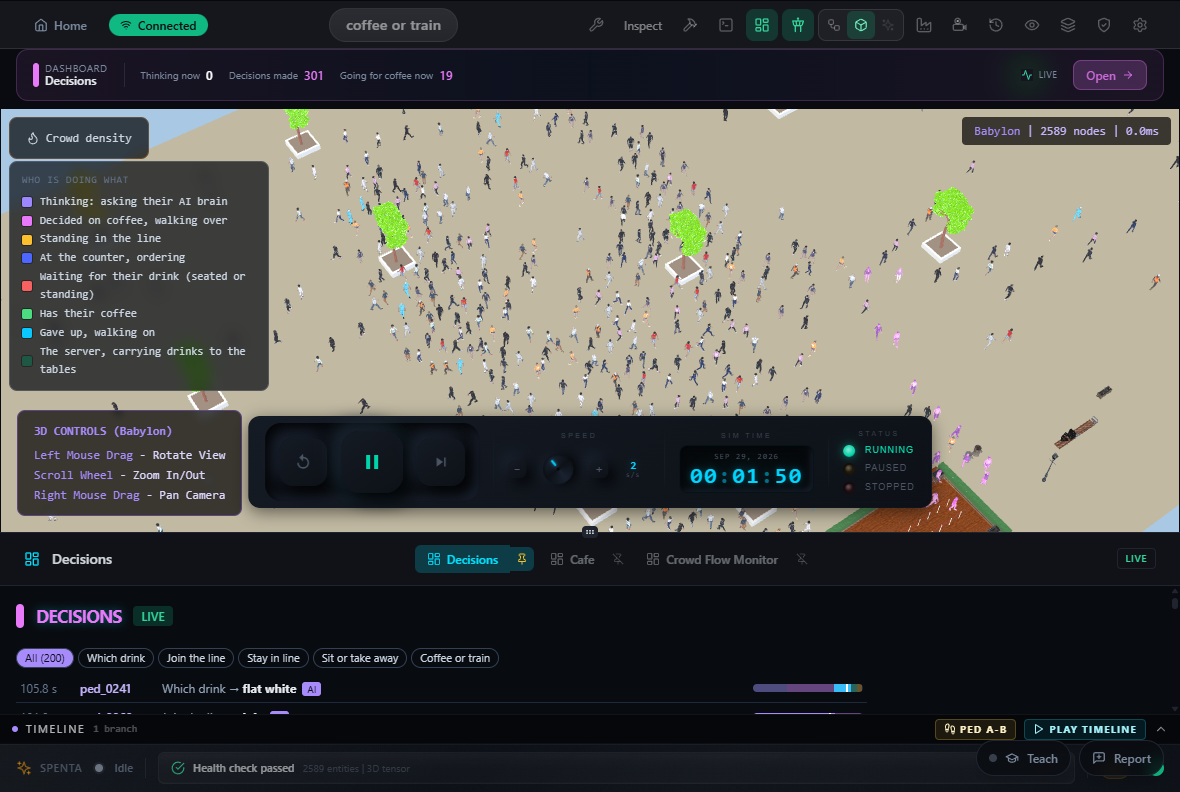
Train or coffee, whether to join a line, whether to keep waiting, what to order, whether to sit
Limits
Machines, windows, staff, seats and the train timetable
Recorded
MovementDoors, routes and open space decide how people reach where they are going.
Recorded · coloured by state
ChoicesEach person decides as they go: train or coffee, join the line or walk on, keep waiting or leave. The colors show what each one is doing.
Recorded
CapacityTwo cash machines, one person at each. Everyone else waits in one line, first come, first served.
Manufacturing
Moves
Parts and cases, carried by conveyors, robot arms, mobile robots, forklifts and people
Decides
Which task each robot and each person takes next, where each part goes, when a vehicle is sent
Limits
Task and station times, belt and buffer space, people's skills and shifts, charging
Everything a factory model needs, as building blocks. Parts, and the kits they become. Conveyors of every common kind: belts, zones, merges, diverts, turntables, spirals, lifts, and automated storage and retrieval. Robot arms whose grip is measured, not drawn. Mobile robots, forklifts and their chargers. People who walk, carry, wait and take the next task. Workstations that hold a part while work is done, and the storage places in between. Each piece follows its own chart of steps, and models link into larger systems, so a line can join its plant and its supply chain.
Recorded
MovementThe mobile robot waits at the cell, then pulls forward and turns onto its own outbound lane.
Recorded · the two charts
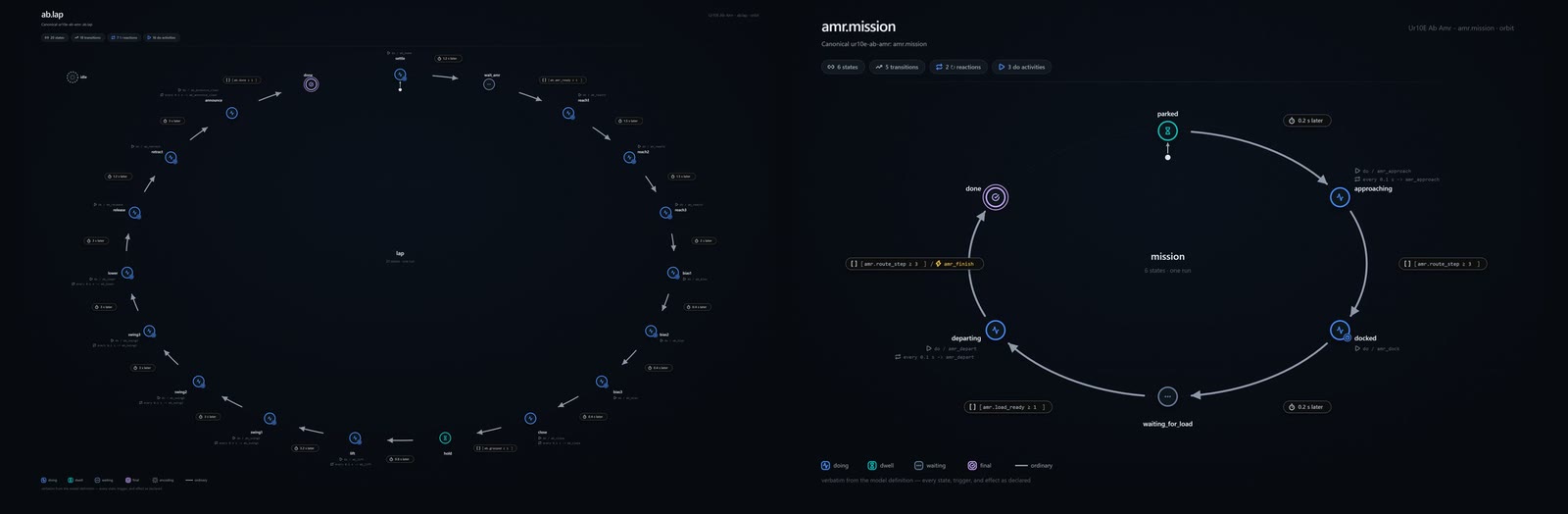
Hand-offsTwo robots, two charts of steps. The arm waits for the mobile robot's 'docked' signal; the mobile robot waits for the arm's 'loaded' signal.
Recorded
ContactThe grip is physics, not animation. The arm does not lift until both gripper pads touch the part.
Warehousing
Moves
Pallets, totes and cartons, carried by forklifts, shuttles, mobile robots, conveyors and people
Decides
Which robot or person takes the next task, where each tote and carton goes, when a robot charges
Limits
Rack and tote locations, station and sorter capacity, people's skills and shifts, chargers, dock doors
Everything a warehouse model needs, as building blocks. Pallets, cases, totes and cartons. Racks and shelving, and the storage places in them. Conveyors of every common kind: belts, zones, merges, diverts, turntables, spirals, lifts, and automated storage and retrieval. Mobile robots, forklifts and their chargers. People who walk, pick, pack, wait and take the next task. Stations that hold work while it is done. Each piece follows its own chart of steps, and models link into larger systems, so a warehouse can join its plants and its network.
Recorded
HandoffA robot waits at the pick face. The dispatcher sends one picker to load it.
Recorded
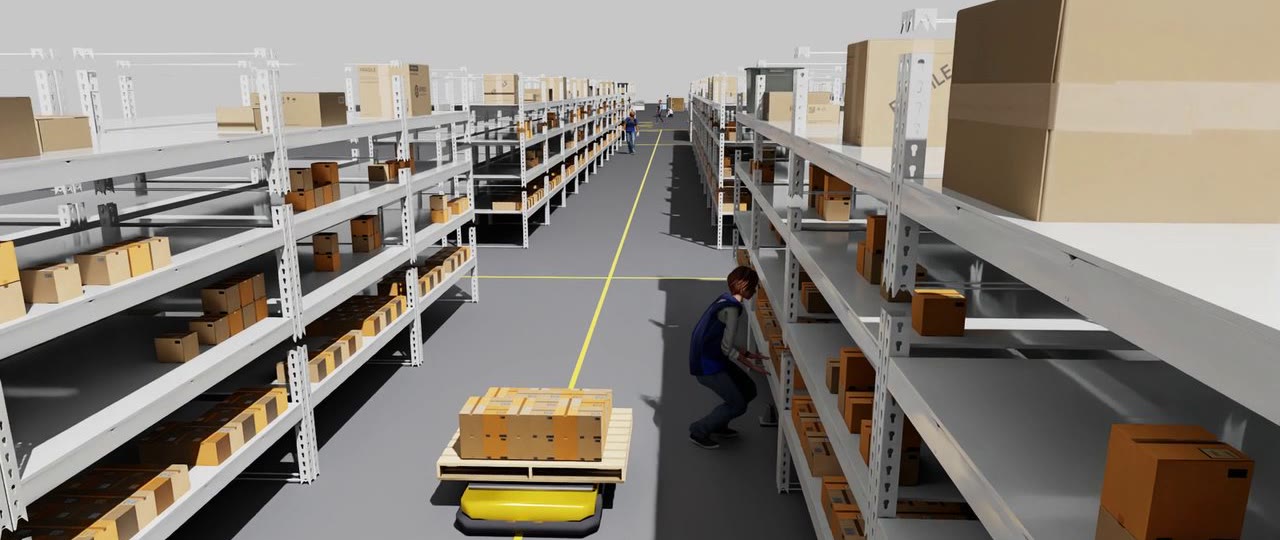
PickingEach case comes off the shelf by hand and goes onto the pallet, built from both sides.
Recorded · still
TrafficRobots keep their distance on a one-way loop, and people cross the lanes straight over.
One graph
Everything in the system can see everything else.
Robots (Full physics): Your robots run in full physics.
People (Agent models): Your humans run as simple agent models.
Conveyors (Discrete events): Your conveyors run as discrete-event flows.
Records (Systems of record): Historical records establish the baseline.
Telemetry (Configured feeds): Configured data feeds can update the state.
Simulation (Possible futures): Simulation compares possible futures.
Spenta (Agent): Built so agents can inspect, control and experiment directly.
Your team (People): The digital twin remains inspectable and editable by human modelers: a structured asset the team can own.
The required connections, refresh intervals and validation are agreed for each implementation.
The ladder
The spectrum of system complexity.
What you model is not one kind of object. It is a spectrum: parts and relationships, nonlinear interactions, adaptive behavior, and finally independent systems coupled into a larger whole.
01 System
G = (V, E)
V
parts
E
relationships
A set of parts connected by relationships: vertices and edges. The base shape of a model.
02 Complex
|E| = O(|V|2)
|V|
number of parts
|E|
number of relationships
Interactions densify as parts multiply. Nonlinear feedback makes the whole irreducible to the parts.
03 Adaptive
st+1 = F(st, θt)
st
state at t
θt
rules at t
The state evolves while agents change their rules from feedback. The system reshapes itself.
04 System of systems
GSoS = (⋃Vi, ⋃Ei ∪ Ex)
Gi
each system
Ex
interfaces between them
Independent systems connect through interfaces. Each keeps its own goals; together they create a capability none can deliver alone.
The interactive 3D view needs WebGL; the formulas and descriptions above carry the same content.
Each step up the ladder adds more parts, more relationships, more feedback, more autonomy and more cross-system coordination. Past a certain point, a human modeler cannot hold all the configurations in their head.
Levels of abstraction
One structure at every level.
Entities, relationships, behaviors and state coexist in one formal structure, from a single machine to a network of systems. Choose a rung to see the graph change; drag to turn it.
Same structureG = ⟨ V, E, Φ ⟩
Graph-theoretic: entities, relationships, behaviors and state, all defined in one formalism.
Same clockT(t + Δt) = T(t) + ∑ events(t)
Only events modify the world, so every state change can be followed through the model.
Explicit handoffsEx
Connect models through explicit exchanges of quantities, units and event timing. Validate the handoff and the combined behavior.
Once independent systems are coupled, the next question is coordination: who sets the purpose, who keeps autonomy, and how much central control exists.
Directed
Central authority manages the integrated whole: a factory floor with sequenced stations.
Acknowledged
Shared objectives, but constituent systems keep ownership and goals: a supply chain with SLAs.
Collaborative
Systems coordinate voluntarily around agreed purposes: trucks sharing a loading dock.
Virtual
No central management or agreed purpose; behavior emerges through interaction: market dynamics.
One supply-chain model can be a mix of all four: a directed factory floor inside an acknowledged logistics network where carriers collaborate for dock access, all operating in a virtual market.
AI in every simulated person
Agents decide for themselves, given where they are and what they want.
Pick a setting. In each one, a simulated person or robot looks at where it is and what it wants, weighs its options and decides.
Illustration of how a dispatch decision reads. Not a recorded run.
Situation
A robot cart is waiting at the face of aisle 4 to be loaded.
Options
Picker AAisle 4nearestfree nowSent
Picker BAisle 2finishing a pick
Picker CPack stationacross the flooron another order
Reason
Picker A is in the same aisle and free, so the robot waits least. B is still finishing a pick; C is across the floor on another order.
The decision and its reason are from a recorded Spenta session, 29 September 2026. The plaza is drawn as an illustration.
Situation
This person is crossing the station plaza. What do they do now?
Options
Get a coffee firstCaféa stop on the way
Catch the trainPlatformin a hurrytrain in 6 minutesChosen
Reason
The person is in a hurry, knows the station, and the train is leaving in 6 minutes. They are alone.
Illustration of how a robot's decision reads. Not a recorded run.
Situation
A finished part is waiting at station 3. Which mobile robot collects it?
Options
Robot 1Next to the lineclose byfree nowSent
Robot 2Line 2carrying a load
Robot 3Chargercharging
Reason
Robot 1 is close and free, so the part leaves the station soonest. Robot 2 is busy with a load; Robot 3 is charging.
Illustration of how a shopper's decision reads. Not a recorded run.
Situation
A shopper comes in with bread and milk on their list. Where do they go first?
Options
Aisle 1Breadon the waynearestChosen
Back wallMilkfurthest
CheckoutPaylist not done
Reason
Aisle 1 is on the way and the bread is nearest, so they pick it up first and head for the milk next. Checkout comes when the list is done.
How the agents thinkEach agent's decision step can use a family of fast decision models, such as Jev, the first System One model from TypeSafe AI. It takes the agent's situation in and returns a typed decision with a calibrated probability for each option, in well under a second.
Past · present · future
Three time horizons. One digital twin.
The same digital twin can be pointed at time in three different ways, each asking a different question.
t − Δttt + Δt
T(t) ⟵ { T(t−Δt), T(t−Δt)′, … }
Rewind, replay what happened, and branch into what could have. Run counterfactuals against the trajectory you already have.
T(t) = Tobserved(t) ∪ Thidden(t)
With a configured data connection, observations can update the model. Estimated states remain model-based inferences; their accuracy and refresh rate must be established for the operation.
T(t) ⟶ { T(t+Δt)1, T(t+Δt)2, … }
Play forward from different starts. Compare scenarios side by side. Decide before you commit.
DT = SoR ⊕ Telemetry ⊕ Simulationsystems of record · configured feeds · possible futures
Historical records establish the baseline. Configured data feeds can update the state. Simulation compares possible futures. The required connections, refresh intervals and validation are agreed for each implementation.
Reasoning you can inspect
No black box. Explain the model. Explain the outcome.
Transparency is architectural, not cosmetic.
01Consistency
Actions follow the constraints represented in the model: a dock cannot load beyond its modeled capacity. Review those constraints with the operating team so the model includes the limits that matter to the decision.
02Soundness
An action must be feasible under the model's stated rules. Confirm that those rules represent the proposed operation; model feasibility alone does not establish that a site can execute the plan.
03Reproducibility
Keep the model version, inputs, settings and random seeds with each experiment. Reproduce a result under the same execution conditions, then use additional seeds to examine variability where the model is stochastic.
04Traceability
Connect the reported finding to its scenario inputs and recorded events. Inspect where a queue, shortage or delay begins, and document any part of the explanation that depends on an assumption outside the model.
05Analyzability
Test the assumptions that could change the choice. Use agreed scenario comparisons and parameter sweeps; where the inputs support it, repeat stochastic experiments and inspect the range of outcomes.
06Compositional
Connect models through explicit exchanges of quantities, units and event timing. Validate the handoff and the combined behavior: a checked warehouse model and a checked network model still need a checked connection.
These describe properties of the model. Using its results for an operating decision also requires checking the data, assumptions and behavior against the operation, within an agreed scope. A formally consistent model can still represent the wrong process.
Your data stays with you.Schemas travel, data doesn't.
The deeper technical conversation happens in person.